Many cat owners become frustrated when their pets suddenly start scratching furniture, knocking items off shelves, meowing excessively, or displaying destructive habits. While these behaviors may seem random, they often have a common cause: boredom and a lack of stimulation. Cats are intelligent, curious animals with strong hunting instincts. When those instincts have no healthy outlet, unwanted behaviors frequently appear. Fortunately, Cat Behavior Enrichment offers practical solutions that can improve behavior quickly while enhancing your cat’s overall quality of life.
Indoor cats especially benefit from enrichment because their environment often lacks the challenges and opportunities available outdoors. Although indoor living provides safety, it can sometimes limit natural activities such as hunting, climbing, exploring, and problem-solving. Consequently, many cats create their own entertainment through behaviors that owners find frustrating. This is where Cat Behavior Enrichment becomes valuable. By creating opportunities for mental and physical engagement, owners can redirect energy toward positive activities.
Behavior problems rarely disappear through punishment. Instead, cats respond best when owners address the underlying cause. Enrichment helps satisfy natural needs while reducing stress, frustration, and boredom. As a result, many common behavior issues improve significantly with the right environmental changes.
The best part is that effective enrichment does not require expensive equipment. Simple adjustments often produce noticeable improvements within days or weeks.
Why Cats Develop Behavior Problems
Before exploring specific Cat Behavior Enrichment ideas, it helps to understand why behavior issues occur. Cats evolved as hunters. Even well-fed domestic cats retain strong instincts to stalk, chase, pounce, climb, and investigate their surroundings.
When these instincts remain unfulfilled, frustration can build over time. Consequently, cats may seek stimulation in less desirable ways. Excessive meowing, furniture scratching, nighttime activity, aggression, and destructive habits often reflect unmet behavioral needs rather than deliberate disobedience.
Environmental stress can also contribute to unwanted behavior. A lack of hiding spaces, insufficient resources, or limited opportunities for exploration may increase anxiety and frustration.
Many owners mistakenly assume their cat is acting out. In reality, the cat may simply be trying to satisfy natural instincts. Therefore, effective Cat Behavior Enrichment focuses on providing appropriate outlets rather than suppressing normal feline behaviors.
Understanding this perspective helps owners approach behavior problems more constructively. Instead of viewing the cat as difficult, they can identify opportunities to create a more stimulating environment.
Interactive Play Sessions
One of the fastest ways to improve behavior involves regular interactive play. Among all Cat Behavior Enrichment strategies, structured play often produces some of the quickest results.
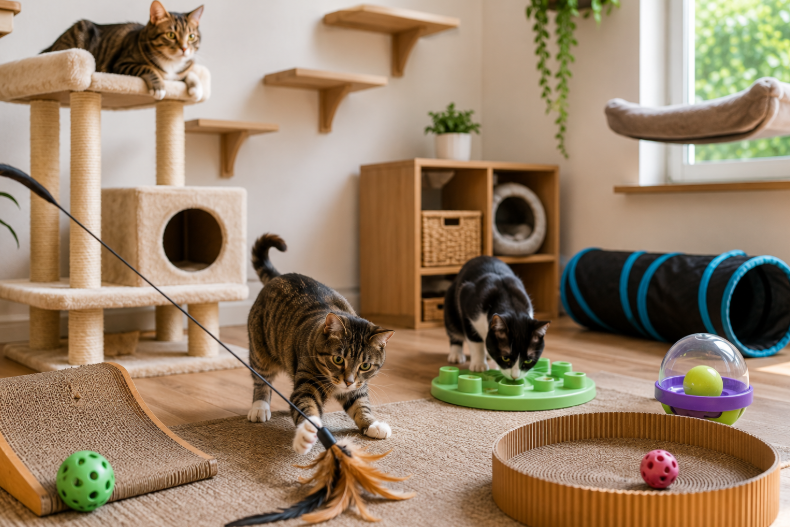
Cats naturally enjoy activities that mimic hunting. Wand toys, feather teasers, and moving objects encourage stalking, chasing, and pouncing. These activities allow cats to express instinctive behaviors in healthy ways.
Interactive play also burns excess energy. Consequently, cats often become calmer and more relaxed afterward. This reduction in pent-up energy frequently leads to fewer behavior problems throughout the day.
Short sessions work surprisingly well. Even ten to fifteen minutes of focused play can make a meaningful difference. Multiple sessions spread throughout the day often provide the greatest benefit.
Owners should vary movements and allow cats to experience successful “captures.” This creates a satisfying hunting sequence that feels rewarding and engaging.
Because physical activity and mental stimulation occur simultaneously, interactive play remains one of the most effective forms of Cat Behavior Enrichment available.
Puzzle Feeders and Food Challenges
Food puzzles transform ordinary meals into stimulating activities. Rather than simply eating from a bowl, cats must solve problems to access food. This approach adds mental exercise while satisfying natural foraging instincts.
Many experts recommend puzzle feeders as an essential component of Cat Behavior Enrichment because they encourage independent engagement throughout the day.
Food challenges slow eating while increasing activity levels. As a result, cats spend more time focused on productive tasks and less time seeking alternative forms of entertainment.
Puzzle feeders come in many forms. Some require batting, rolling, or manipulating objects. Others involve hidden compartments that encourage exploration and problem-solving.
Owners can also create simple homemade puzzles using cardboard boxes or safe household items. Consequently, enrichment does not always require significant financial investment.
Mental stimulation often tires cats as effectively as physical exercise. Therefore, food-based enrichment provides valuable support for behavior improvement while adding variety to daily routines.
Creating Vertical Spaces
Cats naturally enjoy elevated positions. Climbing allows them to observe their environment, feel secure, and satisfy instinctive behaviors. Consequently, vertical territory represents a key component of effective Cat Behavior Enrichment.
Cat trees, shelves, window perches, and climbing structures provide opportunities for exploration and observation. Elevated spaces often reduce stress because cats gain greater control over their surroundings.
Vertical environments also increase usable living space. Even smaller homes can feel significantly larger from a cat’s perspective when multiple levels become available.
Many behavior issues improve when cats gain access to elevated resting areas. Some cats become less anxious, while others display fewer territorial conflicts in multi-cat households.
Window perches offer additional benefits by providing visual stimulation. Watching birds, insects, and outdoor activity helps keep indoor cats mentally engaged throughout the day.
Because climbing aligns closely with natural feline behavior, vertical spaces remain one of the most valuable forms of Cat Behavior Enrichment.
Rotating Toys to Prevent Boredom
Many owners purchase numerous toys only to discover that their cats quickly lose interest. This often occurs because toys remain available constantly.
A more effective approach involves toy rotation. This simple Cat Behavior Enrichment technique keeps familiar items feeling new and exciting.
Instead of leaving every toy accessible, owners can store most toys and rotate selections every few days. Consequently, cats experience renewed curiosity when previously hidden toys reappear.
Different toy types provide different forms of stimulation. Some encourage chasing, while others promote problem-solving or independent play. Variety helps maintain long-term engagement.
Rotating toys also prevents overstimulation. When cats encounter the same objects repeatedly, novelty fades quickly. By controlling access, owners preserve excitement and increase play value.
This strategy requires minimal effort yet often produces noticeable improvements in activity levels and overall engagement.
Providing Safe Exploration Opportunities
Curiosity drives much of feline behavior. Therefore, creating opportunities for exploration forms an important aspect of Cat Behavior Enrichment.
Cats enjoy investigating new scents, textures, and environments. Cardboard boxes, tunnels, paper bags without handles, and safe household obstacles can create engaging experiences.
Novelty stimulates the brain and encourages natural investigative behaviors. As a result, cats remain more mentally active and less likely to seek inappropriate outlets for their curiosity.
Environmental changes do not need to be dramatic. Rearranging a few items or introducing new exploration opportunities periodically often provides sufficient stimulation.
Some owners create obstacle courses or temporary play zones that encourage movement and discovery. These activities help break up routine while promoting healthy engagement.
Exploration-based enrichment supports cognitive health and helps prevent the boredom that often contributes to behavior problems.
Scratching Stations in the Right Locations
Scratching is a natural feline behavior, not a behavior problem. Cats scratch to maintain their claws, stretch muscles, and communicate through scent markings.
Effective Cat Behavior Enrichment includes providing appropriate scratching opportunities in locations where cats naturally want to scratch.
Many owners place scratching posts in isolated areas and then wonder why furniture remains more appealing. Cats typically prefer highly visible locations within active living spaces.
Offering multiple scratching surfaces increases success. Some cats prefer vertical posts, while others enjoy horizontal scratchers or angled surfaces.
Rewarding appropriate scratching behavior further encourages positive habits. Consequently, furniture damage often decreases significantly when scratching needs are met properly.
Rather than attempting to eliminate scratching, enrichment focuses on redirecting it toward acceptable outlets.
Reducing Stress Through Environmental Security
Stress often contributes to unwanted behavior. Therefore, emotional well-being should remain an important part of Cat Behavior Enrichment.
Cats benefit from predictable routines, quiet resting areas, and access to secure hiding spaces. These resources help reduce anxiety and increase confidence.
Covered beds, enclosed spaces, and quiet retreat areas allow cats to withdraw when they feel overwhelmed. Consequently, they often become calmer and more relaxed.
Resource availability also matters. Multi-cat households should provide adequate food stations, water bowls, litter boxes, and resting areas to minimize competition.
Environmental security supports overall behavior improvement because stressed cats frequently display more problematic behaviors.
Creating a safe, predictable environment complements other enrichment activities while helping cats feel comfortable and confident.
Conclusion
Cat Behavior Enrichment offers one of the most effective ways to address common feline behavior problems. Rather than focusing on punishment, enrichment addresses the root causes of boredom, frustration, and unmet instincts.
Interactive play, puzzle feeders, climbing opportunities, toy rotation, exploration activities, scratching stations, and stress reduction strategies all contribute to healthier behavior. These approaches help cats express natural instincts in positive and productive ways.
Many owners notice improvements surprisingly quickly. Simple environmental changes often reduce unwanted behaviors while increasing confidence, activity, and overall well-being.
By embracing Cat Behavior Enrichment, owners create a more engaging and fulfilling environment for their pets. In return, cats often become happier, calmer, and easier to live with. Supporting natural behaviors is not only effective but also strengthens the bond between cats and their families.
FAQ
1. How quickly can enrichment improve behavior problems?
Some cats show improvement within days, while others may require several weeks of consistent enrichment.
2. Are puzzle feeders useful for indoor cats?
Yes. Puzzle feeders provide mental stimulation and encourage natural foraging behaviors.
3. Why do cats need climbing opportunities?
Climbing supports natural instincts, increases confidence, and expands usable living space.
4. Can enrichment reduce excessive meowing?
In many cases, increased stimulation helps reduce attention-seeking and boredom-related vocalization.
5. What is the easiest way to start improving feline behavior?
Regular interactive play sessions are often the simplest and most effective starting point.