
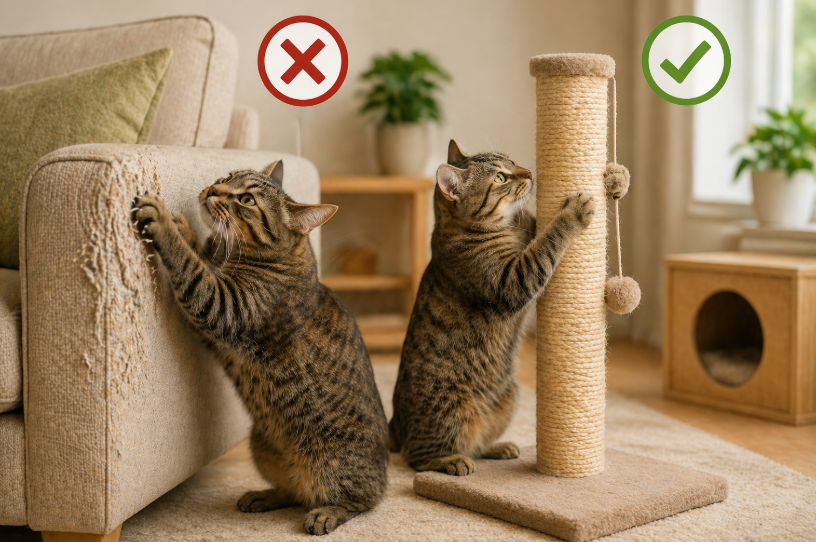
If you feel frustrated because cats destroy furniture in your home, you are definitely not alone. Many cat owners struggle with scratched sofas, torn cushions, and damaged wooden surfaces, often wondering why their pet behaves this way. Although it may seem like destructive behavior, scratching is actually a natural instinct for cats. Understanding why cats destroy furniture is the first step toward solving the problem without harming your relationship with your pet.
Cats rely on scratching for several important reasons. It helps them maintain healthy claws, stretch their muscles, and mark territory. Therefore, when cats destroy furniture, they are not acting out of spite. Instead, they are simply following their instincts. Once you recognize this, it becomes easier to redirect their behavior toward more appropriate outlets.
Understanding Why Cats Scratch Furniture
To truly address why cats destroy furniture, you need to look at the behavior from your cat’s perspective. Scratching is essential for claw maintenance, as it removes the outer sheath and keeps claws sharp. Additionally, cats have scent glands in their paws, so scratching allows them to mark their territory both visually and chemically.
Another reason cats destroy furniture is comfort and accessibility. Your sofa or chair is often located in a central area where your cat spends time. As a result, it becomes a convenient place to scratch. Soft fabrics also provide the perfect resistance that cats enjoy. Because of this, furniture naturally becomes a target unless you provide better alternatives.
Moreover, emotional factors can play a role. Stress, boredom, or lack of stimulation may increase scratching behavior. For instance, a cat that feels anxious or lacks playtime may use scratching as a way to release energy. In such cases, simply addressing the scratching surface may not be enough. You must also consider your cat’s overall environment and well-being.
Signs Your Cat Needs Better Outlets
When cats destroy furniture repeatedly, it often signals that their needs are not fully met. Recognizing these signs early can help you prevent further damage. For example, if your cat scratches the same spot daily, it means they prefer that texture or location. This gives you a clue about what type of scratching post to provide.
You may also notice increased activity at certain times of day. Cats are naturally more active during dawn and dusk, so they may scratch more during these periods. If no proper outlet is available, your furniture becomes the default option. Therefore, observing your cat’s habits can guide your solution.
Additionally, watch for signs of boredom. A lack of toys, climbing structures, or interaction can lead to unwanted behaviors. When cats destroy furniture out of boredom, the solution often involves enrichment rather than punishment. By adding more engaging activities, you can reduce the urge to scratch inappropriate surfaces.
How To Stop Furniture Damage Effectively
Once you understand why cats destroy furniture, you can begin implementing practical solutions. The most effective approach focuses on redirection rather than punishment. Cats respond better to positive reinforcement and environmental changes than to negative reactions.
Start by providing high-quality scratching posts. Place them near areas where your cat already scratches. This makes it easier for your cat to transition to the new surface. Additionally, choose posts with textures similar to your furniture. If your sofa is fabric, a fabric-covered post may work best.
Location matters just as much as the post itself. Cats prefer scratching in visible, frequently used areas. Therefore, hiding a scratching post in a corner may not be effective. Instead, position it where your cat naturally spends time. This increases the chances that your cat will use it.
Another helpful strategy is to make your furniture less appealing. You can use protective covers, double-sided tape, or deterrent sprays. These methods create an unpleasant texture that discourages scratching. Over time, your cat will learn to avoid those surfaces.
Training Your Cat With Positive Reinforcement
Training plays a crucial role when addressing why cats destroy furniture. Instead of punishing your cat, reward them for using appropriate scratching areas. Whenever your cat uses a scratching post, offer praise, treats, or gentle attention. This reinforces the behavior and encourages repetition.
Consistency is key in this process. If you occasionally allow scratching on furniture, your cat may become confused. Therefore, maintain clear boundaries and reward positive behavior consistently. Over time, your cat will associate scratching posts with positive outcomes.
You can also use toys to guide your cat toward the right areas. For example, placing a toy near a scratching post can attract your cat’s attention. Once they engage with the post, reward them immediately. This creates a strong connection between the behavior and the reward.
If cats destroy furniture despite these efforts, patience is essential. Behavioral changes take time, especially if your cat has developed a habit. However, with consistent training and the right environment, improvement is highly likely.
Creating A Cat-Friendly Environment
A well-designed environment can significantly reduce the chances that cats destroy furniture. Cats need opportunities to climb, explore, and play. Without these outlets, they may turn to your furniture for stimulation.
Consider adding cat trees, shelves, or climbing structures. These provide vertical space, which cats naturally enjoy. As a result, your cat will have more options for activity and less reason to target your furniture. Additionally, interactive toys can keep your cat mentally engaged.
Regular playtime is equally important. Spending even a few minutes each day playing with your cat can reduce boredom and stress. This, in turn, lowers the likelihood that cats destroy furniture as a way to release energy. Engaging your cat strengthens your bond while improving behavior.
Furthermore, maintaining a consistent routine helps your cat feel secure. Cats thrive on predictability, so feeding, playtime, and rest should follow a regular schedule. A calm, stable environment reduces anxiety-related scratching and promotes overall well-being.
Common Mistakes To Avoid
When dealing with why cats destroy furniture, certain mistakes can make the problem worse. One common error is using punishment. Yelling or spraying water may stop the behavior temporarily, but it can create fear and damage trust. Instead, focus on redirection and positive reinforcement.
Another mistake is providing only one scratching option. Cats have preferences, so offering multiple posts with different textures can increase success. Additionally, failing to replace worn-out posts can reduce their appeal. Cats prefer fresh, sturdy surfaces for scratching.
Ignoring the location of scratching posts is also a common issue. If the post is not placed in a convenient or appealing spot, your cat may ignore it. Therefore, always consider placement when introducing new scratching options.
Finally, inconsistency can slow progress. If you allow scratching sometimes but discourage it at other times, your cat may become confused. Clear, consistent rules are essential for long-term success.
Conclusion
Understanding why cats destroy furniture allows you to approach the problem with empathy and effectiveness. Scratching is a natural behavior that serves important physical and emotional needs. Instead of trying to eliminate it, the goal is to redirect it toward appropriate outlets.
By providing the right scratching surfaces, creating a stimulating environment, and using positive reinforcement, you can significantly reduce furniture damage. Although the process requires patience, the results are worth it. Your home stays intact, and your cat remains happy and healthy.
Ultimately, when cats destroy furniture, it is a sign that their needs are not fully met. Addressing those needs leads to a more balanced and peaceful living environment for both you and your pet.
FAQ
- Why does my cat keep scratching the same spot?
Cats return to familiar areas because of scent marking and comfort. Providing a similar alternative nearby can help redirect the behavior. - Are scratching posts enough to stop damage?
Scratching posts help, but placement and variety matter. Combine them with training and environmental enrichment for best results. - Can I train my cat to stop scratching furniture completely?
You can reduce unwanted scratching, but not eliminate the instinct. Focus on redirecting behavior rather than stopping it entirely. - Do certain materials attract cats more than others?
Yes, soft fabrics and rough textures are often more appealing. Choosing similar materials for scratching posts can improve success. - How long does it take to change scratching habits?
It varies, but consistent training and proper setup can show improvement within a few weeks.